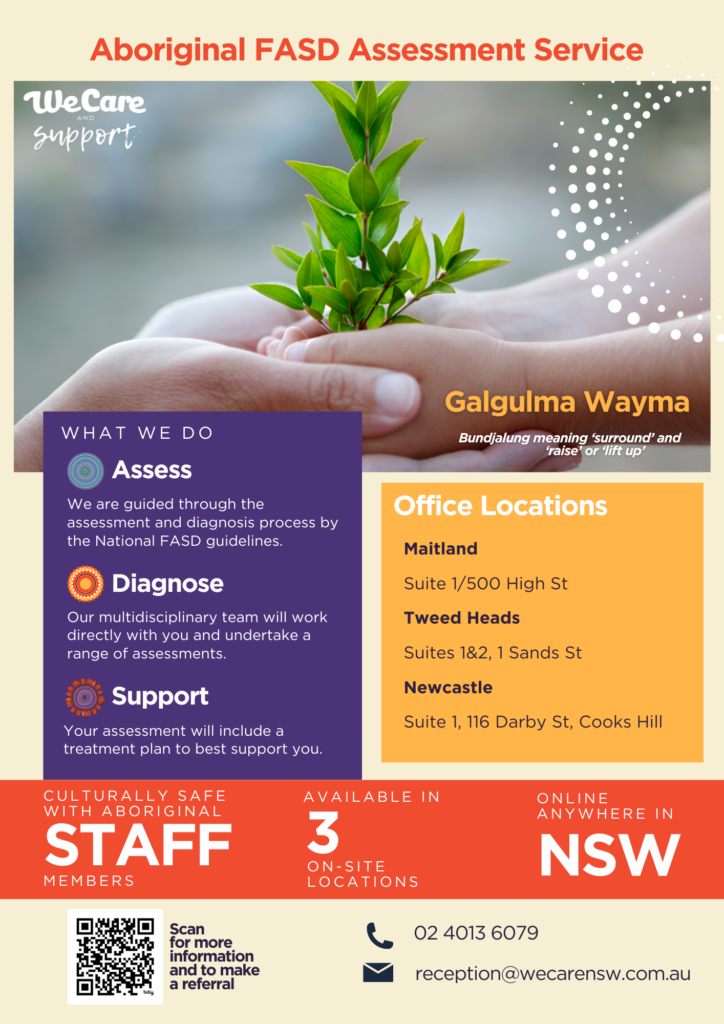
We are dedicated to supporting you like the unique individual that you are through the assessment and management of your FASD.
Our multidisciplinary team of psychologists, behaviour support practitioners and speech therapists are here to assist you and understand your story. The focus will always be building the life that you wish to lead.
Assessment is available on the lands of the Wonnarua, Awabakal, Worimi and Bundjalung people in person, with online opportunities for those across the state.
What is FASD?
FASD stands for Fetal Alcohol Spectrum Disorder and is a group of conditions that can occur in a person who was exposed to alcohol before their birth. These disorders can have lifelong effects, including issues with behaviour, learning and physical limitations.
Galgulma Wayma
In the native language of the Bundjalung people Galgulma Wayma means ‘surround’ and ‘raise’ or ‘lift up’. We chose this name as this is how we want you, and your family and supporters, to feel as you go through your FASD assessment and beyond into support and care that support you as an individual.
What does an assessment look like?
- We are guided through the assessment and diagnosis process by the National FASD guidelines.
Assessments can be completed in a number of settings – living in the community, adult correctional facilities, schools, juvenile justice system or in our offices – for people of any age.
You may have already completed many of the assessments before as they can be used to identify a range of issues and support other diagnoses. You will need to forward copies of these prior to your initial appointment, this can be completed by uploading below or sending them through to our office via fax or email. Documents needed includes:
Education
- School Reports (typically from the last 2 years)
- NAPLAN Results
- Teacher observations or behavioural incident reports
- Birth Records/neonatal discharge summary with birth and length
- Growth chart since infancy with height and weight documented
- Your ‘blue book’ if you have one
Confirmed Exposure
- Prenatal history documentation
- Foster care records indicating maternal alcohol use in pregnancy
- Adoption records indicating maternal alcohol use in pregnancy
- Documentation of maternal alcohol abuse e.g. DUI, substance abuse treatment record
Diagnostic Reports
- Autism Spectrum Disorder (ASD)
- Attention Deficit/Hyperactivity Disorder (ADHD)
- Intellectual Disability (ID)
- Specific Learning Disorder e.g. dyslexia, dyscalculia, dysgraphia
- Developmental Coordination Disorder (DCD)
- Anxiety
- Depression
- Epilepsy
Other Health Assessments
- Hearing
- Vision
- Motor Skills/Coordination
- Adaptive Behaviour
- Cognitive Functioning
- Memory Functioning
- Attention
- Executive Functioning
Support and understanding for mums, not shame
There is no safe level of alcohol usage in pregnancy. Life happens, pregnancy is not always known in the early days and everyone’s journey is different.
We understand that alcohol usage happens for a number of reasons and are not here to judge, but rather to tick that box and make a plan for the future.
Pages
- We Care National Aboriginal FASD Assessment Service
- Are you keen to play D&D?
- Core Supports Form
- Privacy Policy
- Accessing Allied Health Form
- Accommodation Services Form
- Allied Health Referral Form
- Behaviour Support Form
- Child and Family Services Form
- Occupational Therapy Form
- Plan Management Request Form
- Psychology Services Form
- Social and Civic Participation Form
- Speech Therapy Form
- Support Coordination Form
- Community Access Form
- Community Referral Form
- Contact Us
- News
- Development Pathways
- Bringing our values to life
- Current Vacancies
- Work & Grow with Us
- Accessing Allied Health Services
- Speech Therapy
- Occupational Therapy
- Psychology
- Family Support
- Step by Step Foster Care Assessments
- Aboriginal Mentoring
- Individual Placement Arrangements
- Cultural Plans
- Restoration Services
- Family Preservation
- Social and Civic Participation
- Allied Health
- Plan Management
- Child and Family Services
- Core Supports
- Galgulma Wayma Aboriginal FASD Assessment Service
- Support Coordination
- Accommodation
- Behaviour Support
- Services
- Model of Care
- Mission & Values
- About Us
- Home
Categories